Closing the eyes or using a visual barrier changes information without proving that other senses become objectively stronger.
Back to the glossarySensation & activity
Sensory deprivation
The consensual reduction of one or more senses—often sight or sound—to alter attention, anticipation or dependence on communication. Even simple forms require a reliable way to monitor comfort and stop.
Sensation & activity
In brief
Reducing information can also reduce communication and orientation.
In adult kink, sensory deprivation means deliberately reducing sensory information—most often sight or sound—to change attention, uncertainty or dependence on communication. The community term covers anything from closing the eyes to more restrictive equipment, but those situations are not equivalent. This entry remains descriptive and excludes breathing restriction, immobilising combinations and operating instructions.
Lowered auditory input can also remove spoken warnings or environmental cues.
Reducing several senses or movement at once can make communication, balance and orientation substantially harder.
Laboratory or healthcare uses of sensory reduction answer different questions and should not be equated with kink.
Terminology and research limits
Kink writing often says that removing one sense automatically heightens the others. Experimental research is more complicated: short-term blindfolding can alter performance and attention, but effects depend on task, duration and prior experience. A subjective sense of intensity is not proof of enhanced sensory ability.
Direct research on consensual sensory-deprivation scenes is sparse. Broader BDSM studies describe anticipation, vulnerability and negotiated control, while consent research emphasises explicit communication; neither can establish a safe universal method.
Objects, environments and meaning
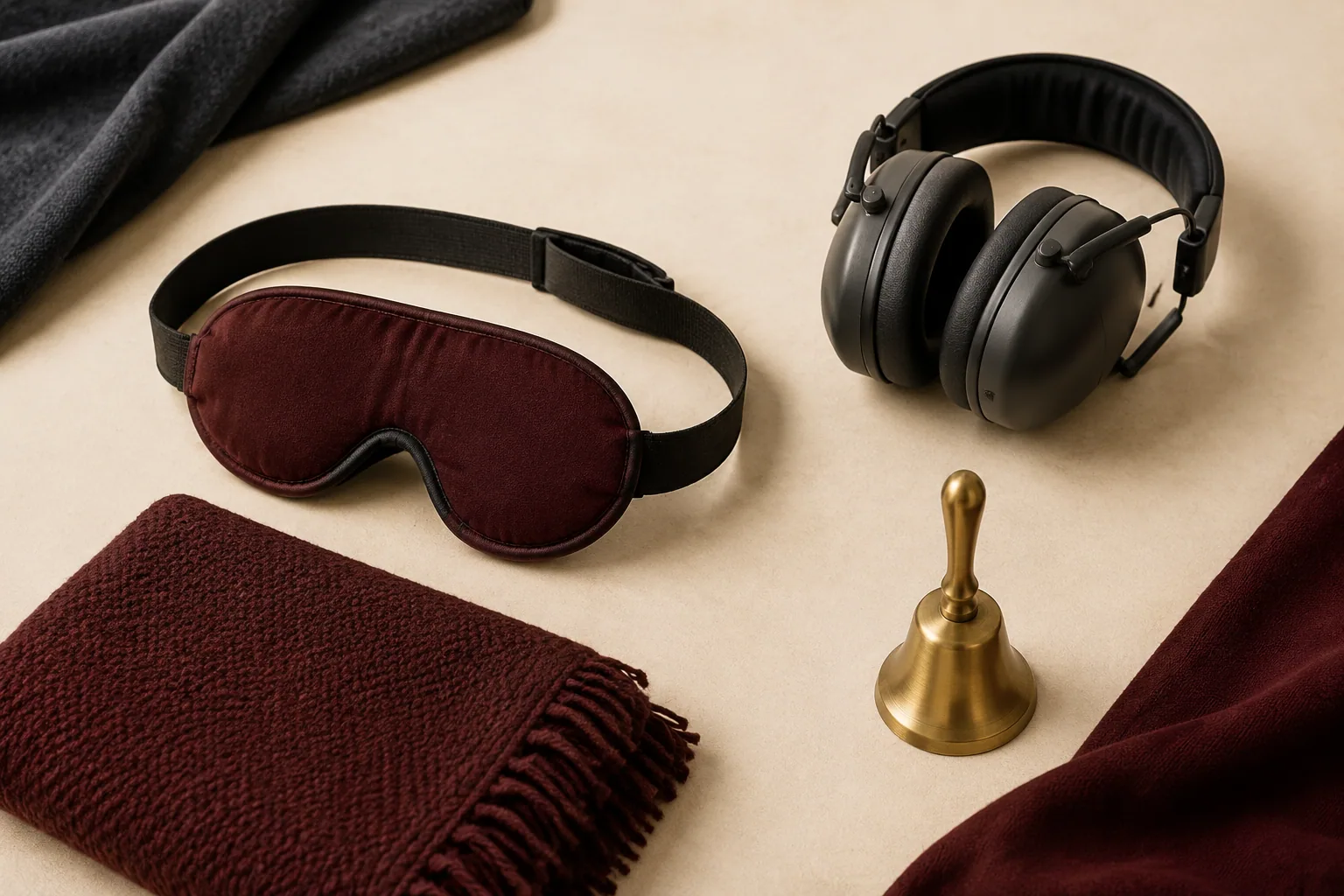
Associated objects may include an unoccupied eye mask, soft visual screen, headphones, ear defenders, textured fabric, signal card or accessible alert device. Darkness, quiet, anticipation and the contrast between known and unknown may matter more than any specific object.
Equipment labels do not capture fit, hearing, balance, sensory processing, trauma history or mobility. A person may find reduced input calming, intense, disorienting or distressing, and that response may change from one occasion to another.
Consent and accessible communication
Agreement should cover which sense is affected, what remains audible or visible, how to stop, and what happens if communication fails. A signal is useful only if the person can reliably use it and another adult can perceive it.
Silence, stillness, delayed response or inability to locate a signal never proves consent. Anything affecting breathing is outside this entry, and combining sensory reduction with restraint can add risks that the separate labels do not reveal.
Wellbeing and clinical distinction
Unexpected panic, confusion, breathing difficulty, loss of responsiveness or inability to communicate requires stopping and appropriate help. An unresponsive person cannot consent; NHS first-aid guidance should take priority over a scene plan.
WHO guidance does not make a consensual adult sensory interest a disorder merely because it is unusual. Clinical concern turns on distress, impairment, serious risk or non-consent, not possession of a blindfold or preference for reduced light.
Non-graphic examples
What the umbrella may include
- An adult choosing to close their eyes during a negotiated sensory scene.
- Using an unoccupied eye mask as a symbol of trust in a photograph or display.
- Agreeing that ordinary speech remains available even when visual information is reduced.
- Selecting an accessible non-verbal signal because a participant communicates differently.
- Stopping when uncertainty changes into disorientation or distress.
Reviewed 30 August 2026
Keep exploring.
This detailed field note uses the best available evidence without treating one community sample as universal. Evidence limits and UK context are stated where relevant.
Prepared by The UK Kink Guide editorial team. Read the evidence and review methodology.
Found an error or important omission? See how to report a correction.
Explore all 268 entries