An adult adopts a stylised canine persona, which may emphasise playfulness, attention, movement or a change in ordinary social expectations.
Back to the glossaryFantasy & performance
Pup play
A form of adult pet play in which a participant adopts a stylised puppy or dog-like persona, often with emphasis on playfulness, pack community, headspace or handler dynamics. It can be social and identity-based as well as erotic.
Fantasy & performance
In brief
An adult persona can be playful, social, erotic—or several at once.
Pup play is an adult role-play and community practice in which someone adopts a stylised puppy or dog-like persona, while another adult may take a handler role or no complementary role at all. Participants describe playful behaviour, altered social expectations, community, relaxation and power exchange in different combinations. It is a human adult performance, not sexual contact with animals, and it is not inherently sexual in every setting.
An optional adult role involving guidance or care within agreed limits; handler is not owner in a legal or literal sense.
Social belonging, friendship, events and identity language that may exist without partnered or erotic activity.
A distinct fandom centred on anthropomorphic characters and creativity; some people overlap, but neither label implies the other.
What pup-play research describes
Wignall and McCormack's exploratory interviews with 30 gay and bisexual men identified themes including persona, headspace, community and routes into pup play. Langdridge and Lawson's phenomenological study likewise explored meaning and embodiment. These small, self-selected samples provide depth but cannot represent all genders, sexualities, countries or forms of participation.
A later community survey broadened the evidence and found diversity in how participants understood the practice, while noting that earlier work had focused heavily on gay and bisexual men. None of these studies establishes one cause, a universal erotic meaning or a population prevalence.
Gear, symbols and sensory features
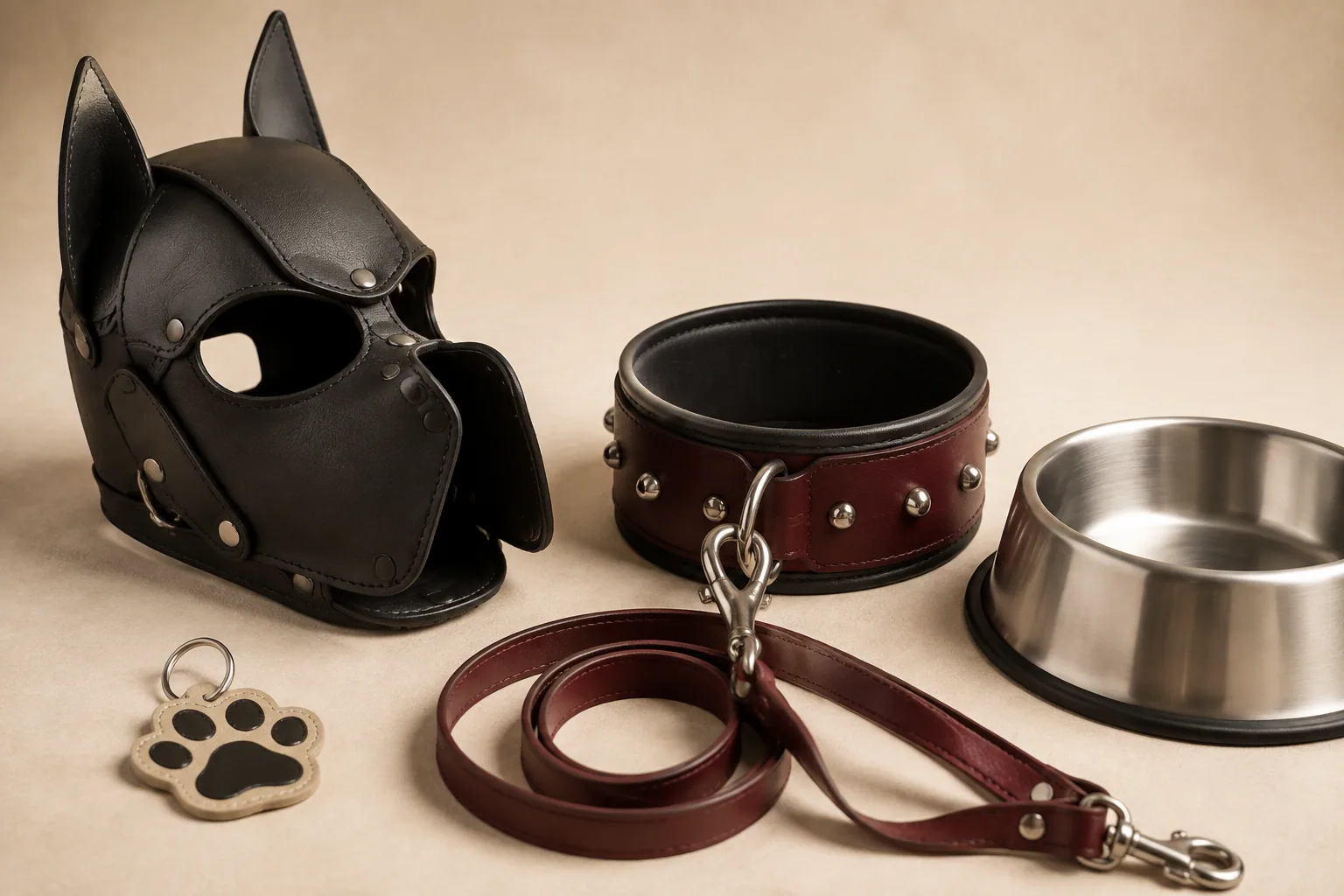
Associated objects can include an unoccupied adult-sized hood, collar, mitts, knee pads, tag, bandana or simple pack emblem. Colour, sound, restricted speech, texture, posture and the visual shift away from everyday presentation may support a persona or sense of community.
Gear is optional and does not establish a role or consent. Hoods and mitts can affect hearing, vision, heat, balance, dexterity and communication; collars can carry personal or relationship meanings that outsiders should not assume. Accessible alternatives and ordinary speech remain valid even if they interrupt the performance.
Consent, role and social space
Agreement may cover names, gestures, touch, commands, photographs, public interaction and how to leave the role. A pup can direct, initiate, pause or stop; a handler does not acquire ownership or blanket authority. Someone who is non-verbal in character still needs an accessible way to communicate and remains entitled to use ordinary language.
At events, other pups, handlers, staff and bystanders have their own boundaries. A social greeting, costume or pack affiliation is not sexual consent, and an adult-only private role-play should not be imposed on a general public setting.
Wellbeing and clinical distinction
Participants in qualitative studies sometimes describe headspace as relaxing, playful or freeing, but that reported experience is not a clinical treatment claim. Gear-related overheating, breathing difficulty, numbness, falls or panic require the role to stop and appropriate help to take priority.
Pup play is not a paraphilic disorder merely because it is unconventional. WHO guidance focuses clinical concern on marked distress, impairment, serious risk or non-consent. This entry excludes animals entirely and concerns only consenting, unambiguously adult humans.
Non-graphic examples
What the umbrella may include
- An adult wearing an unoccupied-style pup hood at an adult-only social event without any erotic activity.
- Two adults agreeing pup and handler roles for a private, playful scene.
- Using a bandana or tag as a persona cue while keeping speech fully available.
- Joining a pack-themed community meetup for friendship and belonging.
- Removing gear and leaving character immediately when heat, balance or communication becomes uncomfortable.
Reviewed 30 August 2026
Keep exploring.
This detailed field note uses the best available evidence without treating one community sample as universal. Evidence limits and UK context are stated where relevant.
Prepared by The UK Kink Guide editorial team. Read the evidence and review methodology.
Found an error or important omission? See how to report a correction.
Explore all 268 entries