Canine-themed adult role-play that may involve playfulness, social identity, relaxation, community or erotic meaning.
Back to the glossaryPower & role
Pet play
Also known as animal role-play
Adult role-play built around stylised animal identities or handler-and-pet dynamics. It can be social, playful, relational or erotic; no actual animals are involved.
Power & role
In brief
Adult identity, play and community—not actual animals.
Pet play is an adult form of role-play in which someone adopts a stylised animal persona, a handler role or a related social identity. Pup play is the best-researched example, but people also use pony, kitten and other imaginative themes. The practice concerns consenting adults performing symbolism and behaviour; it does not involve actual animals or make claims about a participant's species or capacity.
Pony, kitten and other stylised roles have their own imagery and communities, but far less direct research.
A negotiated adult role that may offer guidance, structure or companionship; it does not create ownership or permanent authority.
A distinct but sometimes overlapping fandom centred on anthropomorphic characters; neither label implies the other.
What pup-play research found
Wignall and McCormack's 2017 interview study described the experiences of 30 gay and bisexual men. A later community survey by Wignall and colleagues included 733 participants, primarily from the United States but also internationally, and documented social, sexual and identity-related dimensions. Langdridge and Lawson likewise found varied meanings, including pleasure, relaxation and a change in everyday self-awareness.
These self-selected studies are valuable because they report practitioners' own accounts, but they do not represent every gender, sexuality, country or form of pet play. Self-reported wellbeing benefits are not proof of a clinical treatment, and findings about pups should not automatically be transferred to pony, kitten or other roles.
Names, gear and sensory meaning
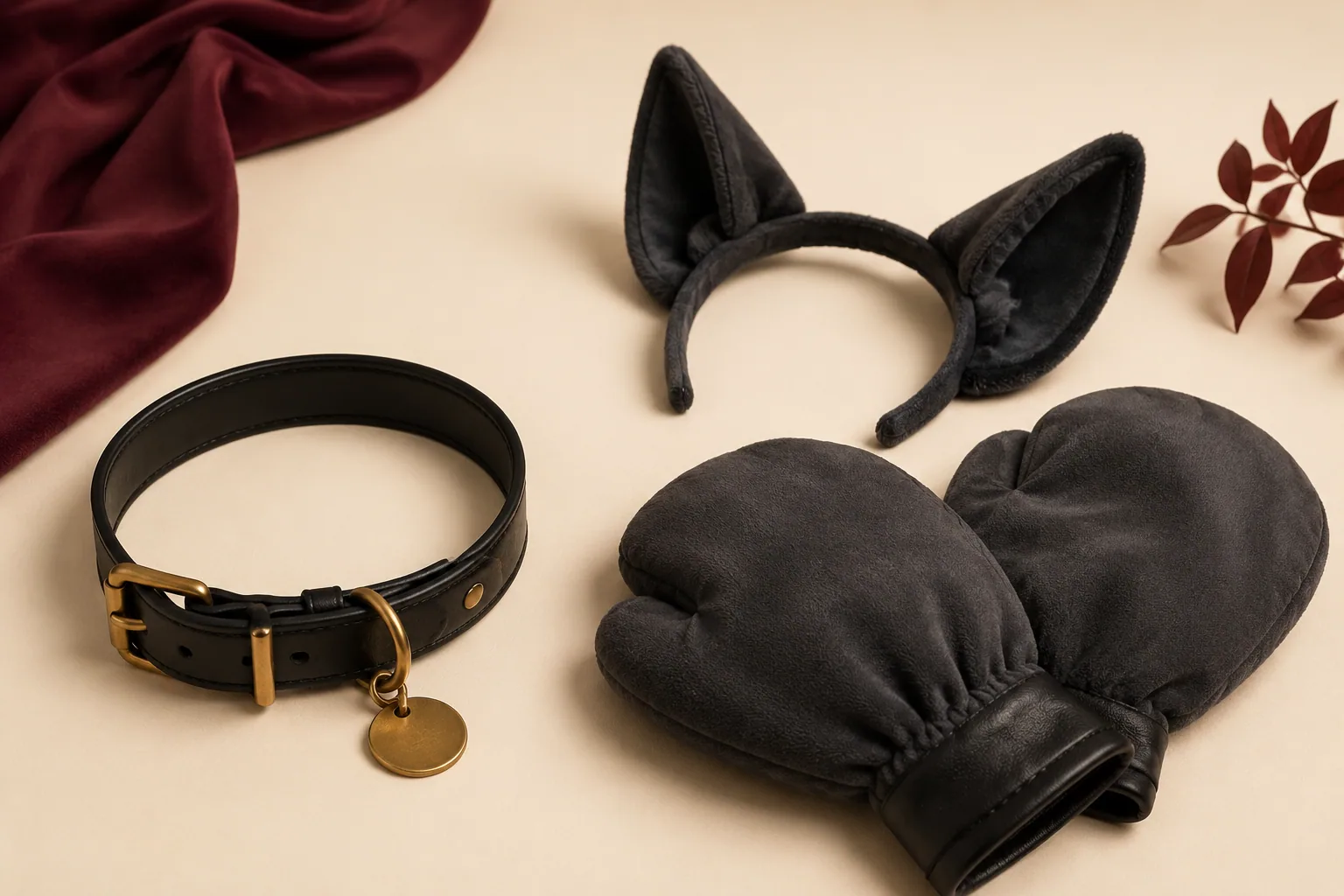
Adults may use a chosen pet name, tag, collar, ears, tail-style costume accessory, mask, mitts, decorative harness, knee protection or water bowl as identity and performance cues. Texture, colour, sound and restricted speech can help some people enter a playful or focused headspace; others use only a name or mannerism.
Gear does not establish a role or relationship by itself. Fit, heat, skin sensitivity, vision, hearing, mobility and communication needs may change what remains comfortable. Close-fitting headwear and any item affecting speech or senses require particular caution, and inability to communicate must never be treated as continuing consent.
Consent, community and public boundaries
Pet and handler roles should have an agreed scope, accessible ways to pause, and permission that can be revised without punishment. A person using playful sounds or limited speech is still an adult whose ordinary words, gestures and wellbeing take priority over character consistency.
Actual animals cannot participate in adult sexual activity and must remain outside it. Bystanders, venue staff and members of the public also do not become part of a scene because someone wears gear. Photography, posting a chosen name and displaying identifying tags require separate agreement because online records can outlast the event.
Clinical distinction and careful interpretation
Research classifies pup play as kink and role-play, not as sexual interest in animals. WHO guidance does not treat an unconventional consensual-adult identity or costume as a disorder merely because it is unusual; clinical requirements concern distress, impairment, serious risk and non-consent.
A mask, collar, animal nickname or community membership is not diagnostic evidence. Nor does a positive community account guarantee that every event or relationship is healthy. The relevant questions remain adult consent, actual conduct, access needs, wellbeing and whether anyone is being harmed or coerced.
Non-graphic examples
What the umbrella may include
- An adult using a pup name and playful mannerisms at a consent-based social event.
- Two adults agreeing a short handler-and-pet scene with an ordinary-language pause option.
- Wearing unoccupied costume ears, a loose tag or other adult-sized accessories as identity cues.
- Taking part in a community meet-up without engaging in an erotic scene.
- Choosing a pony, kitten or other symbolic role while keeping actual animals entirely outside the activity.
Reviewed 30 August 2026
Keep exploring.
This detailed field note uses the best available evidence without treating one community sample as universal. Evidence limits and UK context are stated where relevant.
Prepared by The UK Kink Guide editorial team. Read the evidence and review methodology.
Found an error or important omission? See how to report a correction.
Explore all 268 entries