Open costume or fashion item focused on shape, colour or character.
Back to the glossaryMaterials & dress
Masks and hoods
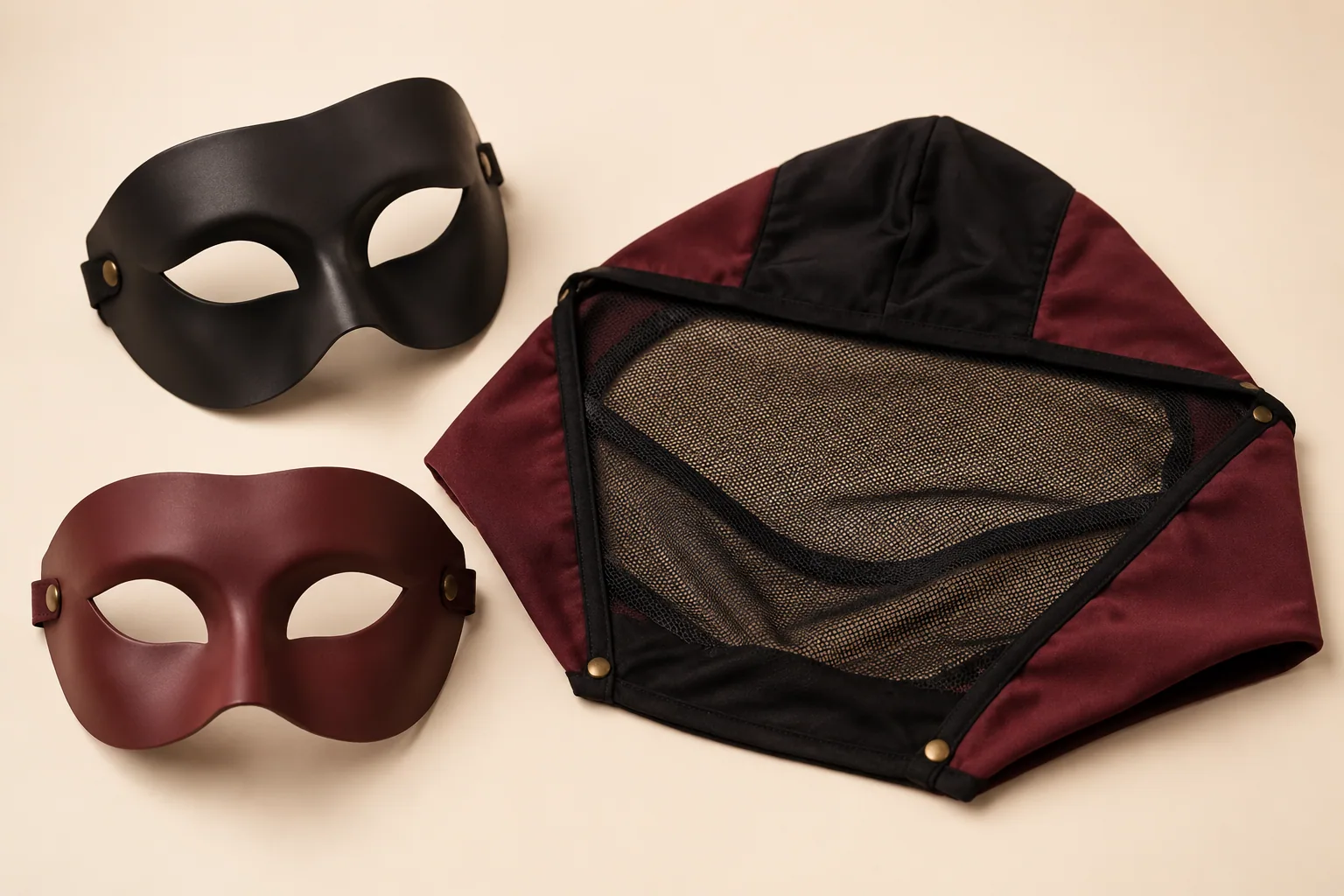
An interest in facial concealment, anonymity, transformation or the visual language of masks and hoods. Designs vary from decorative masks to close-fitting garments, with very different implications for communication, heat and breathing.
Materials & dress
In brief
Concealment can change identity and communication at the same time.
Masks and hoods can function as adult costume, fashion, identity symbols or cues for anonymity and transformation. This category ranges from open decorative masks to close-fitting headwear, so the label alone says little about risk. This page discusses visual and social meanings only; it excludes anything intended to restrict breathing and gives no equipment or technique instructions.
Face covering used to separate everyday identity from a chosen adult persona.
A garment that may alter heat, hearing, vision or speech and therefore carries additional concerns.
Any design or use intended to limit air is high risk and outside this glossary.
Meanings and evidence limits
Masks may support theatrical transformation, anonymity, formality, fantasy or a temporary separation from everyday identity. Broader kink research documents costume, sensory and power-exchange themes, but direct mask-specific evidence is too limited to support prevalence or causal claims.
A face covering does not reveal whether its wearer is dominant, submissive, sexual, social or simply dressed for an event. It also does not establish consent to photographs, recognition, touching or role-play.
Objects, materials and sensory effects
Examples include unoccupied eye masks, masquerade masks, theatrical half-masks and adult-sized costume hoods made from labelled textiles. Colour, symmetry, surface, scent and the contrast between a public and concealed identity may be central.
Headwear can change peripheral vision, hearing, speech, temperature and recognition of facial expression. Material composition, allergies, mobility and communication access therefore matter more than an item's dramatic appearance.
Communication and privacy
Consent should cover what is worn, visibility, duration, photography and an accessible way to stop that remains usable if speech or hearing changes. Silence, stillness or inability to answer is never evidence that consent continues.
Anonymity can be partial: voice, tattoos, room details and metadata may identify someone even when their face is covered. Permission to wear or be seen privately is not permission to publish an image or reveal a chosen persona.
Safety and clinical distinction
Anything that impairs breathing, causes confusion, overheating or a loss of effective communication requires immediate attention; this guide deliberately provides no method for using such equipment. A person who is unresponsive cannot communicate or consent.
WHO guidance does not treat consensual adult costume or concealment as a disorder by default. Clinical concern depends on distress, impairment, serious risk or non-consent. Owning a mask or using an adult persona is not diagnostic evidence.
Non-graphic examples
What the umbrella may include
- Displaying an unoccupied masquerade mask as a symbol of transformation.
- Wearing an open adult costume mask in a private, agreed role-play.
- Choosing a colour or texture that separates a community persona from everyday identity.
- Using separate consent for photographs even when the face is concealed.
- Removing headwear as soon as communication, comfort or orientation becomes uncertain.
Reviewed 30 August 2026
Keep exploring.
This detailed field note uses the best available evidence without treating one community sample as universal. Evidence limits and UK context are stated where relevant.
Prepared by The UK Kink Guide editorial team. Read the evidence and review methodology.
Found an error or important omission? See how to report a correction.
Explore all 268 entries